
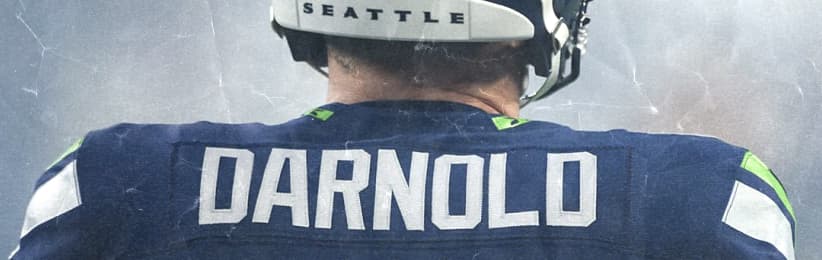
In a way, you could argue that none of this was Sam Darnold’s fault. It was not his choice, after all, to get drafted third overall in 2018 by the New York Jets, the most hapless franchise in modern football. For a quarterback like Darnold, becoming a top-five pick was the spiritual equivalent of winning the lottery, only for him to tumble into a manhole on the way to validating the ticket. You could argue that if the Jets had passed on Darnold with the third overall pick and taken a Wyoming quarterback named Josh Allen instead, we’d be having an entirely different conversation leading up to this Super Bowl. You could even argue that maybe we’d be remembering Josh Allen as the guy who nearly torpedoed his career because he happened to land with the wrong team.
But that, of course, is not the way things worked out. The Jets did anxiously snap up Darnold in 2018, and then spent three years exposing him to their haunted house of a franchise until he began to see ghosts, just as they’d done with one potential franchise quarterback after another over the course of the decades since Joe Namath announced his retirement.
By 2021, faced with the choice of whether to sign him to a long-term deal or cut him loose, the Jets decided they’d had enough of Darnold. They traded him to Carolina, another franchise with a long history of less-than-ideal personnel choices, and decided to roll the dice on another top draft pick, Zach Wilson (whose psyche the Jets also wound up shredding to pieces). After two unremarkable years in Charlotte, the Panthers gave up on Darnold, as well. He became a free agent. He was still only 25 years old, but he stood on the precipice of becoming yet another historic Jets draft bust, a name to be filed in the archives alongside Christian Hackenberg and Browning Nagle.
And look: Not all of the blame for Darnold’s early-career spiral can be placed on the Jets. Over the course of three seasons in New York, Darnold threw 39 interceptions; in 2021, over 12 starts with Carolina, he threw another 13 interceptions. His underlying analytics were better in his final season in Carolina in 2022, but part of the problem was that the initial impression of Darnold became the dominant impression. He was still the guy who struggled under pressure; he was still the guy who saw ghosts. Amid that kind of branding, it would require a visionary coach to believe that Darnold was still worth taking a chance on at all. In a league where groupthink often dominates, it felt like perhaps Darnold’s career was about to fade away.
Which is why it feels kind of profound that just three years later, he wound up here, on the verge of winning a Super Bowl.
The Only Rule In Hollywood
Years before the Jets drafted Darnold, a renowned screenwriter named William Goldman coined the only phrase about Hollywood that’s ever made sense. Nobody knows anything, Goldman said, and what he meant was that the best thing you could do was chase after the ideas you believed in, surround yourself with competent and innovative directors and producers, and then hope for the best.
It feels like a counterintuitive idea to admit that you’re still kind of flying blind in a world so saturated with data. It seems like all the millions and millions of dollars that studios spent on ideating and on hiring focus groups and on carefully crafting test screenings should amount to something. But in the end, it’s impossible to know what might work. The best you can do is take educated guesses and surround yourself with smart people and constantly re-evaluate your own biases along the way.
And sure, Hollywood is not the NFL, but it’s not fundamentally different when it comes to quarterbacks. (One greenlights Marvel sequels; the other greenlights Ryan Leaf and Mitch Trubisky.) Teams spend millions of dollars in an attempt to evaluate quarterbacks, continually hoping they can find a way to game the system. They scout them for years, often starting in high school; they sort and collate using computers and AI models; they consult advanced analytics; they run them through combine drills and psychological tests, knowing that successful quarterbacks require that rare blend of both physical prowess and mental fortitude. They come up with formulas like the one former coach Bill Parcells devised in the 1980s:
- Be a three-year starter
- Be a senior in college
- Graduate from college
- Start 30 games
- Win 23 games
- Post a 2-1 touchdown-to-interception ratio
- Complete at least 60% of passes thrown
All of that reads like a desperate attempt to impose order on randomness. (A lot of it is also hopelessly outdated at a time when nearly every quarterback in the league completes 60 percent of their passes.) The truth is that, even now, with more intelligence than ever available to NFL teams, no one really knows anything. According to a 2024 examination by The Athletic writer Jacob Robinson, the chances of a top 10 quarterback becoming a success over the course of the previous dozen or so years was roughly 50-50. All that time and money spent trying to gain an edge, and it’s still all kind of a dart throw.
And that leads us back to Sam Darnold, and the idea that maybe the best way to ensure that you’re on the right side of those 50-50 odds is to be humble enough to admit that you don’t know anything, either. Because a huge portion of that success or failure will hinge not only on the talent of the quarterback, but on providing that quarterback with an atmosphere where every decision he makes won’t be viewed as a referendum on his future.
Darnold’s Third (and Fourth) Chance
In 2023, Darnold chose to sign as a backup quarterback with the San Francisco 49ers in order to work under coach Kyle Shanahan, one of the most innovative offensive minds in the sport. This, Darnold said, was a conscious choice. “Being in a really good organization was a priority for me,” Darnold told ESPN. “Being with really good coaches and really good personnel as well. Those were kind of the top things for me.”
Shanahan had shown interest in Darnold as far back as 2021, before the 49ers wound up with Purdy. Darnold spent the 2023 season playing behind Purdy, consulting with Shanahan, and essentially resetting his entire approach. In 2024, he signed with Minnesota and revitalized his career under another innovative offensive mind, Vikings coach Kevin O’Connell.
Darnold led the Vikings to the playoffs and a 14-3 record–but even then, after a disappointing playoff loss to the Rams, the Vikings weren’t sure if they’d found the right guy. They let Darnold sign with Seattle, and turned their attention instead to second-year quarterback J.J. McCarthy, which now seems like an unnecessary reset that may have cost them a chance at the Super Bowl. In 2025, McCarthy was one of the worst quarterbacks in the league in Minnesota, and Darnold was one of the best. The Vikings went 9-8 and missed the playoffs; the Seahawks went 14-3 with Darnold, beat the 49ers and Rams in the playoffs, and are now 4.5 favorites over the New England Patriots in Super Bowl LX on February 8th.
The Vikings had outsmarted themselves when it came to Darnold, just as the Panthers and the Jets had outsmarted themselves before that. They looked around, saw a sexier, younger option, presumed Darnold had a ceiling that didn’t ever include a Super Bowl, and cast him aside. And in doing so, they’d proven once more that when it comes to quarterbacks, no one knows anything.
The Matchup Nobody Saw Coming
And so we wind up here, with the most unlikely Super Bowl matchup ever, and with two quarterbacks who truly felt like 50-50 propositions before the season began. In the preseason, the Seahawks’ odds of making the Super Bowl were roughly 60-1; the Patriots odds were 80-1. As unlikely as it is for Darnold to be here, it’s almost as surprising that Patriots quarterback Drake Maye, only 23 years old, arrived here as fast as he did. Maye was regarded as a boom-or-bust prospect when the Patriots drafted him with the number three overall pick in 2024 (the same spot where Darnold had been chosen six years earlier). Former NFL player and ESPN analyst Merril Hoge declared that Maye was “the kind of player that will get you fired”; Bears general manager Ryan Poles reportedly mocked Maye while watching tape of him before the draft.
None of that matters now, except to reinforce that the best way to overcome an imperfect system is not to give in to groupthink. Kyle Shanahan didn’t see ghosts when he looked at Sam Darnold in 2023; he saw a quarterback who had landed in subpar situations with arguably subpar organizations, and who needed a second chance. The Patriots were fearless enough to ignore the naysaying about Drake Maye and to risk their future on a quarterback who was still finding himself. They evaluated the evidence as it arose, and then re-evaluated as more evidence arose. They were willing to admit that they didn’t know anything, and in a league that too often trades on certainty, that might be the only edge that matters.
Michael Weinreb is a writer and journalist and the author of Throwbacks, a bestselling Substack newsletter about sports, culture and history.