
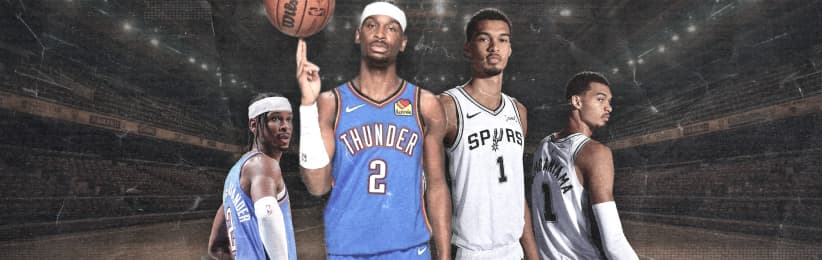
One series that could decide who owns the next ten years.
The marquee series of the Conference Finals was bound to take place in the West. While Game 1 of the Eastern Conference Finals was rather entertaining in the drama it presented, the Western Conference Finals commenced with an emphatic bang, followed by a back-and-forth affair in Game 2.
The billing speaks for itself. The MVP vs. the DPOY. The one seed vs. the two seed in the West. The best record in the regular season vs. the second-best. A budding dynasty vs. the apparent rebirth of one that faded over a decade ago.
Let’s dive into the series that may define the next decade of the NBA.
Game 1: A New Hope
Game 1 of the 2026 Western Conference Finals was a masterclass in modern postseason basketball, offering a detailed blueprint of how structural adjustments and elite physical attributes can override schematic planning. Moreover, it was a spectacle that provided suspense and drama, notching its place among the greatest playoff games in NBA history.
The San Antonio Spurs’ 122-115 double-overtime victory over the Oklahoma City Thunder did more than just steal home-court advantage. It exposed minor cracks in the top-seeded Thunder’s top-rated defense while demonstrating the rapid maturation of San Antonio’s young core.
The unique gravity of The Alien
The defining analytical story of Game 1 was Victor Wembanyama’s overwhelming structural impact. Finishing with a staggering 41 points, 24 rebounds, and 3 blocks over 49 minutes, Wembanyama dictated the geometry of the court.
San Antonio strategically used him as both an interior anchor and a spatial relief valve. When the Thunder defense collapsed on drivers, Wembanyama’s length allowed him to catch high passes and finish above the rim, collecting 9 offensive rebounds. Defensively, his presence in the paint completely disrupted Oklahoma City’s preferred driving lanes, shifting the visual landscape for the Thunder’s primary playmakers.
Check out the latest NBA odds at Lucky Rebel.
Neutralizing the MVP
Oklahoma City’s offensive engine is built on Shai Gilgeous-Alexander’s ability to manipulate drop coverages and get to his spots in the midrange. San Antonio countered this by aggressively deploying length at the point of attack.
With De’Aaron Fox sidelined, the Spurs asked rookie Dylan Harper and sophomore Stephon Castle to spearhead their perimeter defense. The results were highly effective:
- SGA’s Inefficiency: Gilgeous-Alexander was forced into an inefficient 7-of-23 shooting night. While he managed 24 points and 12 assists, he was frequently pushed off his preferred spots.
- The Young Backcourt Impact: Dylan Harper filled the stat sheet with 24 points, 11 rebounds, and a historic 7 steals. Stephon Castle added 17 points and 11 assists, though his 11 turnovers highlighted the immense pressure applied by OKC’s defense.
The Spurs systematically used length to seal off the middle of the floor, forcing the Thunder to beat them from the perimeter rather than through paint penetration.
The Thunder’s Tactical Pivot
When a primary scoring option is capped, elite teams find alternative math advantages. Thunder coach Mark Daigneault adjusted by leaning on the three-point line, using veteran guard Alex Caruso as a pseudo-spacing hub.
Caruso responded with a spectacular 31-point night, hitting 8-of-14 from beyond the arc. Oklahoma City targeted the brief moments when Wembanyama had to rotate, using drive-and-kick sequences to find Caruso in the corners. Jalen Williams also alleviated pressure by adding 26 points in his return from a hamstring injury, attacking the second side of the floor before the Spurs’ rim protection could reset.
The Rebounding Deficit
Despite Chet Holmgren’s admirable defensive effort—including a critical regulation-saving block on Wembanyama—the Thunder were thoroughly beaten on the glass. Holmgren grabbed 8 rebounds, but Oklahoma City lacked the collective bulk to match San Antonio’s frontline, leading to a critical disparity in second-chance opportunities during the overtime periods.
The Overtime Threshold
In the extra frames, the game devolved into a battle of execution versus fatigue. San Antonio’s late-game strategy focused on hunting mismatches, forcing Caruso or smaller guards to switch onto Wembanyama deep in the post. Wembanyama sealed the game in the second overtime with back-to-back dunks, exploiting a worn-down Thunder interior.
Ultimately, Game 1 revealed that while Oklahoma City possesses the shooting variance and defensive grit to stay in any contest, San Antonio has an unguardable physical escape hatch when their set plays break down. To level the series in Game 2, the Thunder must find structural ways to keep Wembanyama off the offensive glass and generate cleaner looks in transition for Gilgeous-Alexander — feats the Thunder accomplished in Game 2.
Game 2: The Empire Strikes Back

Following a double-overtime thriller in Game 1 that saw the San Antonio Spurs steal home-court advantage behind a monstrous 41-point night from Victor Wembanyama, Game 2 of the 2026 Western Conference Finals was a classic back-against-the-wall test for the Oklahoma City Thunder. At Paycom Center on Wednesday night, the Thunder responded like the defending NBA champions they are, grinding out a 122–113 victory to level the highly anticipated series at 1–1.
The MVP Dictates the Pace
The story of Game 2 was the emphatic bounce-back performance from Thunder superstar Shai Gilgeous-Alexander. After struggling with efficiency in the series opener, the back-to-back MVP took control early. Gilgeous-Alexander dismantled San Antonio’s suffocating defensive shell by hunting his preferred mid-range spots and relentlessly driving into the teeth of the defense. He finished the night with 30 points, 9 assists, and 4 rebounds while shooting 12-of-24 from the floor.
More importantly, Gilgeous-Alexander’s gravity opened up the floor during the game’s critical juncture. Early in the fourth quarter, with the Thunder clinging to a fragile two-point lead, SGA returned to the floor and spearheaded an 11–0 run. Though he didn’t score directly during that stretch, his elite facilitation created open look after open look, effectively breaking the game open and giving Oklahoma City the cushion they needed.
Bench Superiority & The Turnover Battle
While Gilgeous-Alexander anchored the star power, the game was ultimately won on the margins. Thunder head coach Mark Daigneault relied heavily on his depth, and his second unit delivered a masterclass. Oklahoma City completely dominated the bench battle, outscoring San Antonio’s reserves 57 to 25.
Alex Caruso was spectacular off the pine, providing defensive intensity and timely offense to finish with 17 points on 3-of-4 from deep. Jared McCain and guard Cason Wallace added 12 points apiece, giving OKC an injection of perimeter shooting and secondary playmaking that the Spurs simply couldn’t match.
Furthermore, the Thunder drastically cleaned up their execution, turning San Antonio’s uncharacteristic sloppy play into direct offense. Driven by 4 steals each from Wallace and backup guard Ajay Mitchell, OKC forced 21 Spurs turnovers, flipping them into a decisive 27–10 advantage in points off turnovers.
Spurs’ Valiant Push Falls Short
San Antonio did not go quietly. Despite playing without point guard De’Aaron Fox, who sat out due to an ankle injury, the Spurs leaned on their young core. Stephon Castle stepped up to lead San Antonio with 25 points and 8 assists, although his night was marred by a costly 9 turnovers (resulting in a series total of 20 in a span of two games). Devin Vassell caught fire from the perimeter, drilling six 3-pointers en route to 22 points.
Meanwhile, Victor Wembanyama remained an absolute force in the interior. Though the Thunder disrupted his Game 1 scoring rhythm, the 7-foot-4 superstar still turned in a commanding 21 points, 17 rebounds, 6 assists, and 4 blocks. But it was a clear contrast from his dominance in the first chapter of this series, with Thunder head coach Mark Daigneault deploying Isaiah Hartenstein as a highly physical foil for Wembanyama. Hartenstein treaded the thin line between acceptable physicality and blatant fouling to wedge Wembanyama off his comfort zone on both ends of the floor. The Spurs will have much to say about Hartenstein’s rather questionable tactics, but they may have to find a tactical counterpunch rather than counting on officiating to adjust.
San Antonio managed to trim a double-digit deficit to just five points with 1:25 remaining in regulation, even forcing an offensive foul on Gilgeous-Alexander. However, the comeback vanished when Vassell missed a potential momentum-swinging 3-pointer generated by a classic Spurs “Hammer” set, followed immediately by a Castle turnover. A dagger step-back jumper from Gilgeous-Alexander and a driving layup by Caruso iced the victory for Oklahoma City.
Series Outlook
With the series tied 1–1, the battle shifts to the Frost Bank Center in San Antonio for Game 3 on Friday, with the Spurs retaining home-court advantage. The Thunder successfully prevented an 0-2 hole, but the Spurs proved that even when plagued by high turnovers and a thin bench, their high-ceiling young core can go toe-to-toe with the league’s best.
Health questions remain on both sides. Jalen Williams was forced to exit Game 2 early with hamstring tightness, while Ajay Mitchell was taken out of the game late due to a right leg injury – the same designation applied to Spurs’ rookie Dylan Harper, who also was forced out of the game prematurely. De’Aaron Fox’s status remains in question heading into Game 3.
It has been a rough-and-tumble two games, one that sees the Spurs (-125) and the Thunder (+105) in a virtual deadlock. Wembanyama’s burden is to find solutions against the physical defense being played against him in the paint. Gilgeous-Alexander continues to find pockets of efficiency and impact that will make use of his MVP status toward winning the series.
Joe Viray is a Lucky Rebel NBA guest writer who actually watches the tape. He covers the Warriors for Golden State of Mind and the wider league for SBNation. Follow him at @JoeVirayNBA.