
Knowing about tires can uncover solid racing edges
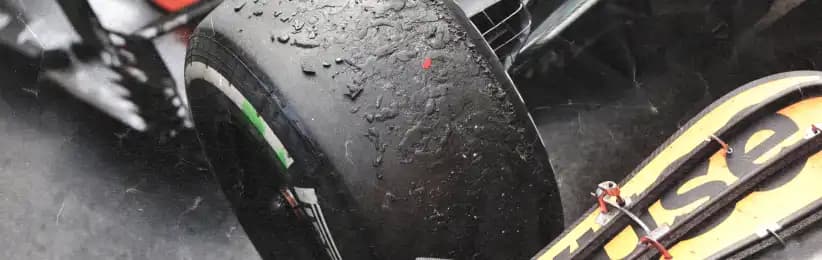
F1 tire strategy decides more races, podiums, and fastest laps than most people think.
That’s if they think about tire strategy at all. It’s not sexy compared to the big names and iconic teams. If you understand how degradation and pit windows actually work, you’re already ahead of a big chunk of the market.
Why Tires Run the Show in Modern F1
Modern F1 racing is a lot of things. Netflix brought all the camera angles and drama between teams, teammates, and principals.
The boring stuff that really matters to teams and to F1 bettors is tire management. Pace, race length, and mandatory compound rules force every team to build their whole Sunday – their whole weekend – around rubber as much as raw engine power. Tires could matter even more, actually, since the engines are so close to each other performance-wise.
Pirelli brings three dry compounds from its C1–C5 range to each race. Race fans know that they’re labeled hard, medium, and soft for that weekend. They might also know that drivers have to use at least two different dry compounds in a normal dry Grand Prix, but what does the smart money need to know beyond that?
They need to understand how tires factor into pit stop strategy, undercuts, and overcuts. They get why a car that looks untouchable in clean air on lap 10 can suddenly be a sitting duck by lap 25. The sharps understand tires are the limiting factor and often the difference-maker when the checkered flag comes out.
F1 betting odds are heavily influenced by tire strategies and regulations. You can see this in the stark contrast between pre-race winner prices and live, in-race odds when tire degradation runs higher or lower than expected. Teams must constantly adjust for countless variables in today’s F1 when it comes to managing their rubber.
Check the latest odds on Lucky Rebel.
Austrian Grand Prix Tire Factors
The Red Bull Ring in Austria is a textbook example. It’s short and fast with enough key corners to wear tires down fast. It’s usually hot in late June/early July too. The 2026 running looks hotter than ever, with temps heading close to 100 degrees.
This means teams will have to plan around higher‑than‑average wear and at least a two‑stop race as the optimal approach. When temps spike as this and track temperatures head toward a scorching 120 degrees or higher, tire life drops off. The tires get greasier. Race and tire strategy get somewhat more aggressive and conservative at the same time. F1 bets need to keep up.
Race strategy gets more aggressive when it comes to pit stops. You’ll see them more often. Earlier in the race. Teams can’t set it and forget it like in Monaco or Monza, or even Vegas. In Austria, you’ll see them lean towards undercuts because older tires fall off so hard that pitting first is a strong attack move.
Actual driving strategy, meanwhile, gets more conservative. Managing matters as much as pushing hard. That means backing off in dirty air to cool the tires. Easing off the throttle more in slow corners to keep them cool too.
Your F1 Austria bets should reflect who you think are the smarter teams and the more nimble, flexible drivers.
Tire Degradation 101
Degradation. You’ll hear it from the race geeks and pay attention, while the casual money is looking to see if Brad Pitt or a Kardashian is walking the paddock. It’s the rate at which a tire loses performance.
In F1 that translates directly to lap time and race win probability. As a tire wears, the rubber overheats, the surface blisters, and the contact patch shrinks. That turns into less grip, longer braking zones, and poorer traction out of slow corners. When you catch the term “fall off the cliff”, then you should also pay attention. You’re cheering as your +1200 car is holding steady at 0.3s off the leader lap‑for‑lap, but then he suddenly drops a full second a lap once the tire “falls off the cliff.” It’s the point of no return, and it’s a big part of degradation and tire strategy.
You already know that most F1 races are a constant trade‑off between pushing harder now and killing the tires sooner or nursing them with a conservative approach and extending them a few laps while the rest of the field pits.
If degradation is expected to be modest – unlikely in the mid-summer heat of Austria, but good to spot when betting other F1 races – a one‑stop race strategy can work. That means track position becomes king. If it’s a steep decline in wear – like it often is in Austrian summer heat, you’re looking at two-stop strategies.
Two-Stop Betting Strategies
Two-stop F1 races open the door to big pace swings. You could see more safety car gambles, which is good for finding an edge in betting. There’s often a lead change later on too, with late charges on fresh tires. A good time to throw in a podium finish bet for a longer shot with a nice payout attached. If a midfield car can match the big brand-name teams on degradation, that’s the kind of F1 betting edge that can see them on the podium at +800 or even higher. Those late charges can score you a fastest lap win.
Hot, tire-beating tracks like Austria just open up the field more.
For bettors, Austria can be complex when it comes to these added variables. It can be simple though, if you prefer a more straightforward deciding factor for betting: the car with the best long‑run tire profile. It’s often more dangerous over 71 laps at the Red Bull Ring than the car that tops the qualifying sheets. As we mentioned, you’re looking at two stops minimum at Red Bull Ring on Sunday.
Pit Windows and Undercuts
Pit windows are the lap ranges where a switch to another compound will improve the car’s total race time. Within those windows, the undercut lives and dies by tire wear and performance.
At a race like the 2026 Austrian Grand Prix, teams know that historical data. Two‑stoppers often beat conservative one‑stoppers when the race runs hot (and green). If you see early laps where the projected leaders are nursing the pace to hit a one‑stop window at the same time a slower car commits to an aggressive two‑stop, that’s a sign to change up the live race winner and podium markets before the books make their own corrections.
For betting, undercut windows matter most for in‑race timing. When a car in P3 or P4 with strong long‑run pace ducks into the pits slightly early, and they’re pitting into clean air, that could be a signal to top-up their podium bets if you’re live betting F1. Hedge on the other side of that move if it’s a bad stop. Either way, you could beat the books, timing-wise.